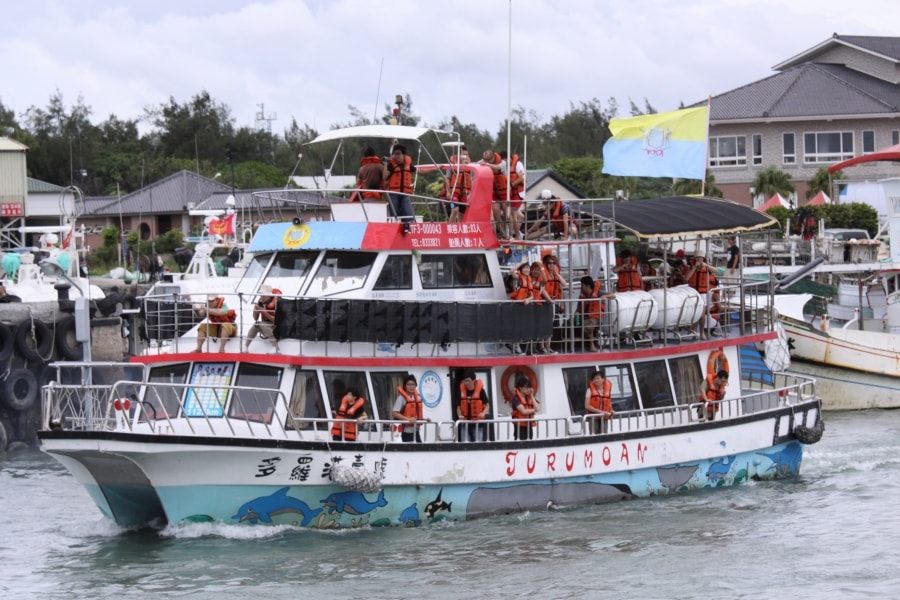
The curatorial project “POST.O” was presented in multiple locations: Museum of Contemporary Art, Taipei, Garden City Publishers, Atelier New Day St., and Shitiping tribe, Hualien. There were 13 individual/group of local and international artists involved. Besides exhibition, there was also a cruise action.
The curatorial project “POST.O” was presented in multiple locations: Museum of Contemporary Art, Taipei, Garden City Publishers, Atelier New Day St., and Shitiping tribe, Hualien. There were 13 individual/group of local and international artists involved. Besides exhibition, there was also a cruise action. This circular trip started from Tamsui, travelled through Siziwan, Kaohsiung, to Dagangkou, Hualien, then back to Tamsui Port. Through this action of circling the sites around the main island, it reviewed the fact of “TOPOS”.
The concept of “POST-O” was not avantgarde, nor was it a topic from international art scene. It started to form through thinking about possibilities amongst artists, and the contextual quality within the arts. First was to challenge the concept of an “exhibition site”. “POST-O” formed its imagination around this concept. It was neither a single exhibition site, nor multiple exhibition sites; it was about “the formation of exhibition sites”. We started with Museum of Contemporary Art, Taipei, and the resources and power connections around MOCA Taipei, to create “sub-structures”. These were: MOCA Plaza, MOCA Studio, Zhongshan Metro Mall for Books, Garden City Publishers, Yeh Wei-Li’s Atelier New Day St., POST.O Maru, Art Zone Dagangkou. Artists or artist groups each worked on extended projects of “TOPOS”; including the topo of “local field work”, topo of “memories of history”, topos of “legend” or “sci-fi”; topo of site-specific actions in international collaborations; topos of expressing space for living or shifts of identity; topos of virtual lives and living in foreign land; topo in connecting with “plug-in”; topos of message exchanges or displays (in charge by the curatorial team); last, the possibilities of time in working with topos. This could be executed in various extensions in platforms and events. All these efforts were to “re-form” discussions. Further more, discussions could be a form of topo document: this is the beginning point of “cal-curating”.